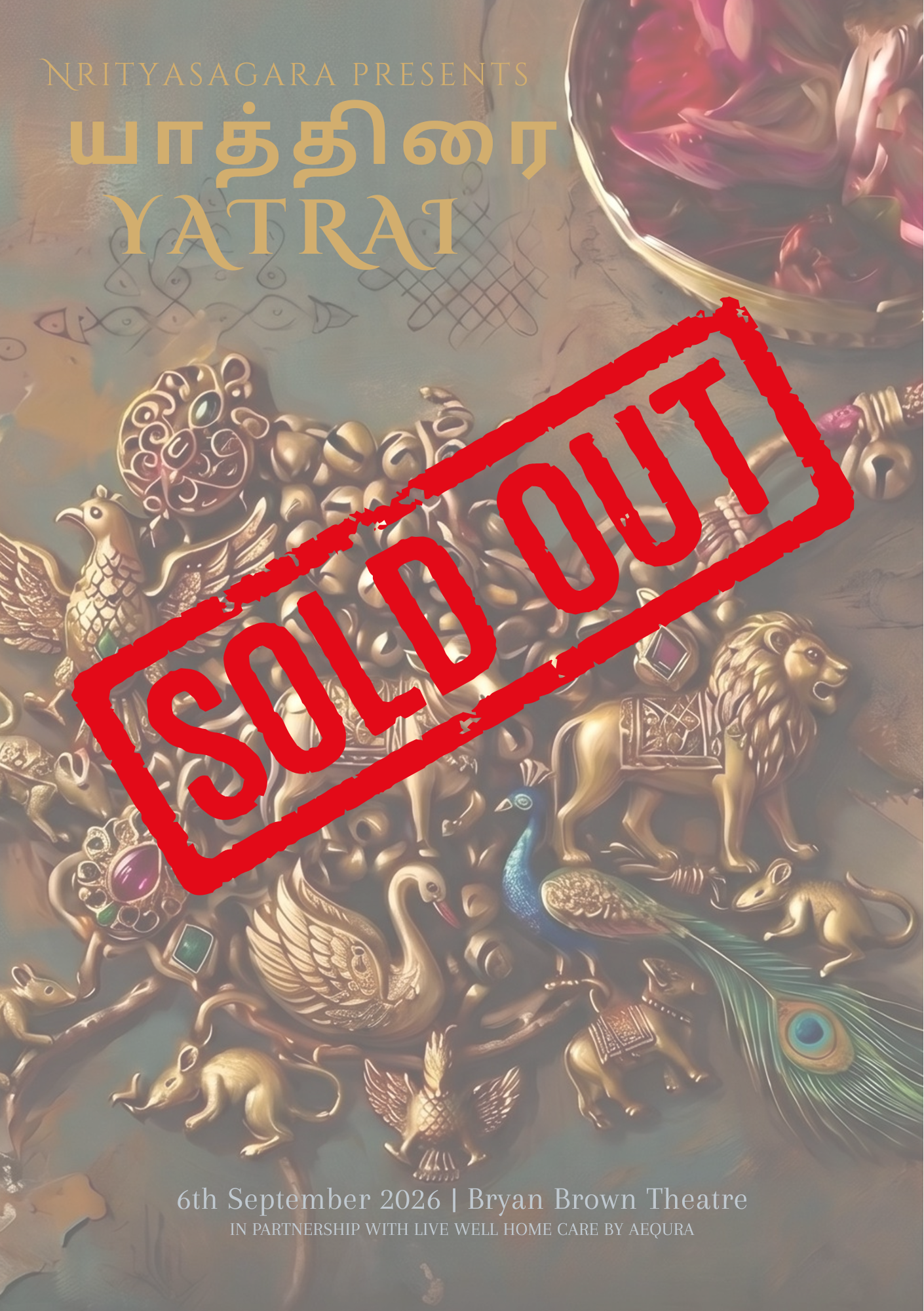
Every year, choosing the theme for our annual showcase is the part of the creative process I find both most exciting and most difficult.
It has to mean something. Not just visually — though the visual world we create around a theme matters enormously — but structurally. The theme has to be able to hold an entire evening of Bharatanatyam. It has to give our students something to reach toward. It has to connect our repertoire to a larger idea.
This year, the theme arrived the way the best ideas usually do. Not fully formed, but as a feeling first, and a word second.
The word was Yatrai. யாத்திரை.
What the word means.
Yatrai is Tamil. It translates most simply as "journey" — but Tamil is a language that layers meaning, and this word carries more than a single translation.
It means journey. It means pilgrimage. It means a festival in which a deity is taken in procession — carried through the streets on their vehicle, seen by the people, brought into contact with the world. And in one of its older meanings, yatrai also means dance itself.
In a single word, you have movement, devotion, procession, and the art form we practice. I found that I couldn't walk away from it.
The vahanas.
Every Hindu god and goddess travels on a vahana — a sacred vehicle, usually an animal or bird, that carries the deity through the cosmos and serves as their emblem.
Vishnu rides Garuda, the great eagle — swift, all-seeing, the enemy of serpents, a symbol of the divine mind in flight.
Shiva's vahana is Nandi the bull — steady, devoted, the gatekeeper of Mount Kailash, who sits forever facing the lingam in perfect, patient worship.
Ganesha's vehicle is a mouse — and this is the one that always makes people think. Ganesha, the remover of obstacles, the Lord of Beginnings, the enormous god of wisdom — rides a tiny mouse. The symbolism is precise: the mouse represents the ego, the small scurrying desire-mind that drives humans to gnaw through things. Ganesha sits atop it, in control, not in denial of it.
Saraswati, goddess of learning and the arts, rides a swan — the hamsa, which in Hindu mythology can separate milk from water, purity from impurity. A fitting vehicle for the goddess of discernment.
Murugan, the god of war, rides a peacock — the bird that faces the serpent without fear, the creature whose feathers carry the eyes of watchfulness.
Durga rides a lion. She who contains within herself all the power of the gods combined, her vehicle equally fearless, equally unconquerable.
Each vahana is not merely a mode of transport. It is a statement of the deity's nature. You know who a god is by what they ride.
Why this theme for Bharatanatyam.
Bharatanatyam has always been devotional at its root. Even in its most technically abstract form — pure nritta, footwork without narrative — there is an underlying quality of offering. Of the body given over to something larger than itself.
A showcase built around vahanas gives our students the opportunity to enter that devotional world directly. Each piece in our repertoire this year connects to a specific god, a specific vahana, and the qualities that vehicle embodies. When a student dances the piece devoted to Ganesha's mouse, they're not just performing — they're inhabiting a particular understanding of the ego, of humility, of the relationship between vastness and smallness.
That is a lot to ask of a ten-year-old. And yet every year, our students rise to exactly what the art form asks of them. That is what makes this work worth doing.
The procession.
The other dimension of yatrai that drew me is the image of procession.
The annual temple festival — the thiruvilaa — involves the deity being taken from inside the temple out into the streets on their vahana. The god comes to the people. The sacred and the everyday meet.
There is something about that image that feels right for a showcase. We are not keeping Bharatanatyam inside a temple. We are bringing it out — onto a stage, into a theatre, in front of an audience that may include people who have never seen this art form before. We are saying: look. This is what has been kept alive. This is what your children are learning. Come and see it.
Yatrai is a procession. Our students are both the dancers and the vehicles — carrying something forward.
What to expect on the night.
The showcase takes place on 6th September 2026 at Bryan Brown Theatre, Bankstown. Across the evening, audiences will encounter each of the major vahanas through performance, costume, and music drawn from the Carnatic classical tradition.
This is not a competition. There are no judges. There is no winner. There is only the art form, offered as completely as our students know how to offer it.
— Amesha Darshana, Founder, Nrityasagara School of Dance