Why We Never Stop Practicing the Basics
Category: Teaching Philosophy | Reading time: ~4 minutes
My husband was talking to our sons recently about professional soccer — specifically, about the fact that players at the very top of the sport still do the same drills they learned as small children. Kicking a ball against a wall. Trapping it. Passing it back and forth, over and over, for no audience, with no applause.
One of our sons asked the obvious question: why? They're professionals. Surely they're past that.
It's a question I get too, in a different form. A student — or more often, a parent — will ask why we're still working on adavus after years of training. Why we return to the same basic hand positions, the same foundational steps, when there are more elaborate pieces to learn, more impressive things to show at the next school event.
The answer is the same in both cases, and it's not really about the drills at all.
Bharatanatyam is a dependent art form — dependent, specifically, on the strength of what lies underneath what an audience actually sees. The elaborate footwork, the emotive storytelling through abhinaya, the intricate rhythmic patterns — none of it holds up if the fundamentals beneath it are shaky. A dancer can learn to fake their way through a complicated sequence for one performance. They cannot fake their way through a lifetime of dancing. Eventually, the gaps show.
So we return to basics. Not because a student hasn't earned the right to move on, but because moving on was never really the goal. Depth was.
What adavus actually teach.
There's something else at work in this repetition that's easy to miss if you think of adavus purely as building blocks for choreography — steps to be assembled, later, into a dance.
A real understanding of adavus does more than prepare a student to execute someone else's choreography correctly. It teaches them how choreography itself is built. The counting, the rhythmic structure, the way one unit of movement combines with another to form a phrase — this is, in a real sense, mathematical thinking. Students who understand adavus deeply aren't just remembering sequences. They're learning a grammar. And once you know a grammar, you can do more than recite what's been written in it. You can compose.
This is the difference between a student who has memorised a piece and a student who has understood it. The first can perform what they've been taught. The second can take the same vocabulary and create something of their own — because the logic underneath the movement has become theirs, not just the surface of it.
What I've learned from staying with the fundamentals myself.
I don't say any of this as someone standing outside the practice, watching students revisit their basics from a safe distance. I still work on mine. Adavus I learned decades ago still show up in my own practice, and every time I return to them, I notice something I hadn't noticed before — a nuance.
That's the part that's hard to explain to a student who is eager to move forward: the basics don't get boring because they don't stay the same. You change. Your body changes, your understanding changes, your relationship to the movement changes — and so the same adavu you learned in your first year of training will teach you something different in your tenth, and something different again in your twentieth. I am, genuinely, a better dancer for having kept returning to mine. Not despite the repetition. Because of it.
What this means for how we teach.
This is why our classes never really "graduate" away from the fundamentals, no matter how advanced a student becomes. It isn't because we don't trust their progress. It's the opposite — it's because we take their progress seriously enough to keep it standing on solid ground.
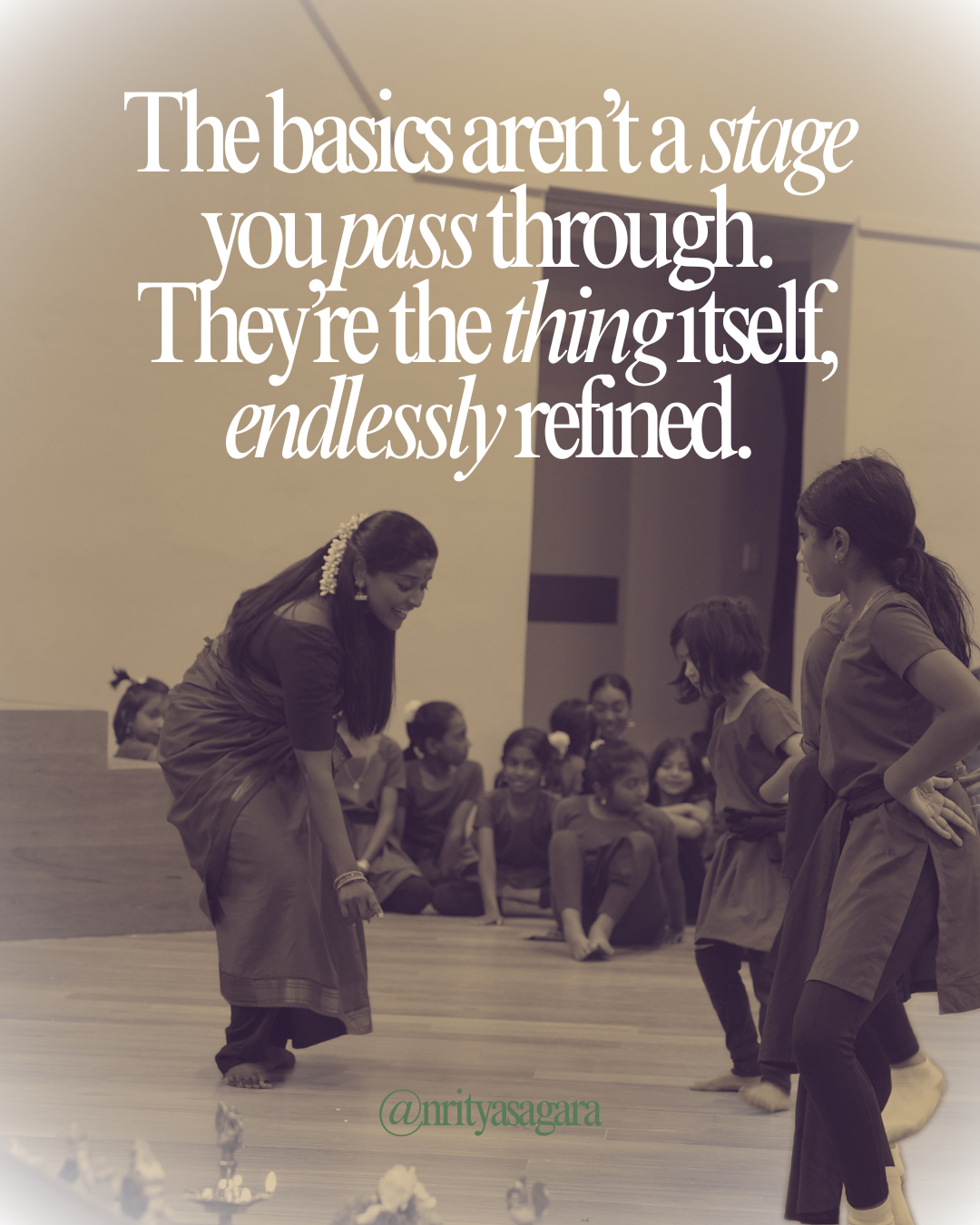
The soccer player kicking a ball against a wall isn't behind. The dancer revisiting an adavu she has done a thousand times isn't stuck. Both of them understand something that's easy to lose sight of when the flashier parts of an art form or a sport are the ones people notice: the foundation isn't the boring part you get through on your way to the real thing. It is the real thing. Everything else — the choreography, the creativity, the depth — is just what becomes possible once it's strong enough to hold.
— Amesha Darshana, Founder, Nrityasagara School of Dance